What ISACA CDPSE Domains Mean on the Job
Every time you press play on a streaming app, a quiet chain of data decisions kicks off behind the screen. Your viewing history shapes recommendations, your device ID feeds an ad system, and your profile sits in a database someone has to protect. The people who design those systems and keep them honest often hold a credential called CDPSE, short for Certified Data Privacy Solutions Engineer, issued by ISACA.

A smiling professional with arms crossed in a modern office, with a lock icon glowing on a screen behind him and a certificate graphic beside him
Entertainment is a handy lens here because most of us already feel how personal data flows around us. This article walks through the four CDPSE exam domains the way they show up in a normal work week, rather than the way a syllabus lists them. If you are weighing the exam, it should help you decide where to spend your study hours.
The exam at a glance
According to ISACA's published exam content outline, the CDPSE exam covers four job practice domains and consists of 120 questions. The weights ISACA lists are Privacy Governance at 20%, Privacy Risk Management and Compliance at 18%, Data Life Cycle Management at 23%, and Privacy Engineering at 39%. Details such as exam duration and passing score are not stated on that outline page, so check ISACA's exam candidate guide for the current figures before you book.
One thing stands out immediately. Nearly four in ten questions sit in Privacy Engineering. That tells you the credential is aimed at people who build and configure things, not only those who write policy.
Privacy Governance: who decides what, and why
Governance sounds abstract until you see it at work. Picture a product team that wants to add a "continue watching on any device" feature. Someone has to ask whether the company has a lawful reason to link those devices, who approves the change, and where the decision gets recorded.
In day-to-day terms, this domain is about roles, accountability and written commitments. You might help draft a privacy notice that a normal person can read. You might maintain a register of what personal data the business holds and which team owns each item. You might sit in a review meeting and point out that a new vendor will receive customer email addresses, which means a contract needs privacy terms first.
Good candidates understand that governance is not paperwork for its own sake. It is the thing that lets an engineer, a lawyer and a marketer make the same decision for the same reasons.
Privacy Risk Management and Compliance: weighing what could go wrong
This domain, at 18%, is where you learn to turn a vague worry into something a team can act on. Suppose a fan site wants to collect birth dates to unlock age-restricted content. A privacy risk assessment asks what could go wrong, how likely it is, and how bad it would be for the people involved.
On the job, that means running privacy impact assessments, rating risks, recommending controls and tracking whether they got done. It also means reading regulations and translating them into plain tasks. When a new law affects how you store customer records, someone has to map the legal text to actual systems and gaps.
The exam rewards judgment here. Questions tend to present a situation and ask for the most appropriate next step, not the most technical one. A common trap is jumping to a fix before the risk has been understood.
Data Life Cycle Management: following information from birth to deletion
This is the domain that touches the most systems. Personal data is collected, stored, used, shared, archived and eventually destroyed. At each stage, different questions apply.
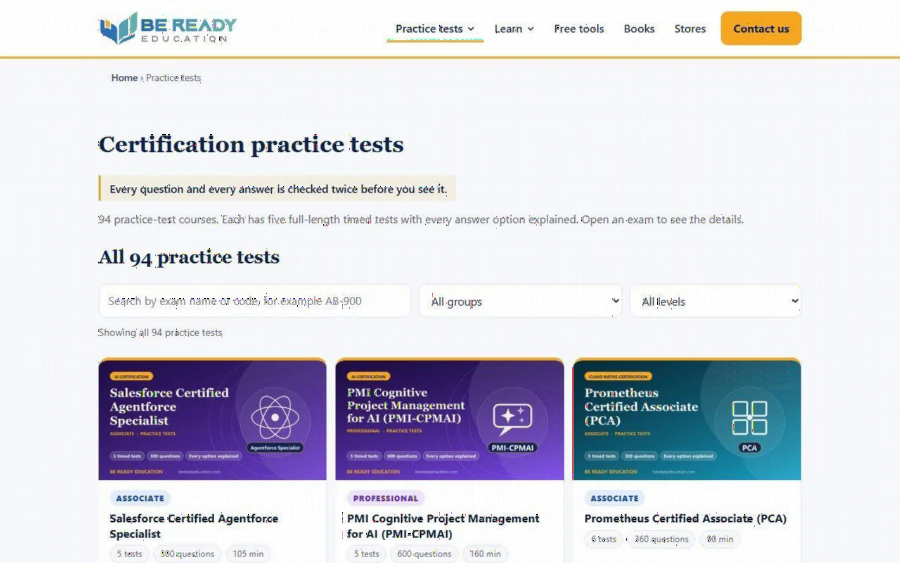
The Be Ready Education practice tests page showing a grid of certification practice test courses with five timed tests each
Think about a loyalty program for a cinema chain. At sign-up, you decide what to collect and whether you really need a phone number. During use, you decide who can see it. When a member asks to be removed, you need to know every place the data lives, including backups and the analytics warehouse, so deletion actually happens.
In practice, you will find yourself working on retention schedules, data inventories, data flow maps and processes for access or deletion requests. The 23% weight reflects how much of real privacy work is simply knowing where the data is and what rules apply at each point.
Privacy Engineering: building protection into the system
Privacy Engineering carries the biggest share at 39%, and it is the part where the credential differs most from a pure compliance qualification. This is about designing systems so that privacy is built in, not bolted on afterwards.
Day to day, that can mean choosing encryption for data at rest and in transit, applying pseudonymization so analysts can study viewing patterns without seeing names, and setting access controls so a support agent sees only what a ticket needs. It can mean reviewing an architecture diagram and asking where personal data crosses a boundary. It can also mean configuring consent signals in an app so a user's choice is respected by every downstream tool.
If you come from an IT, security or software background, this domain will feel familiar, but the exam asks you to think from the individual's point of view. A control that protects the server but ignores what the user agreed to is not a complete answer.
How to study with these domains in mind
Because the domains map to real tasks, the best preparation connects each concept to a scenario. When you read about a retention schedule, ask what would break in a real system if the schedule were ignored. When you study encryption options, ask which one fits a mobile app that stores a viewing profile.
Timed practice matters too. A 120-question exam rewards stamina and steady reading, and many candidates lose points by rushing through the wording of scenario questions. Practice sets that explain every answer option help you see why the right choice is right and why the tempting alternatives are not.
One option is the ISACA CDPSE practice tests from Be Ready Education on Udemy. It is a set of five practice tests with 120 questions each, 600 questions in total, and every question comes with an explanation. It is independent study material and is not affiliated with ISACA. It will not replace ISACA's own guidance or hands-on experience, so treat it as a way to rehearse the format and spot weak domains, then go back to the official outline to fill gaps.
A sensible study plan
If you have a few weeks, split your time roughly in line with the weights, but add extra hours to whichever domain feels least familiar. A lawyer might spend more time on Privacy Engineering, while a developer might need more on governance and compliance.
Take one practice test early to find your baseline. Review every missed question by domain, not just by score. Then study the weak domain using ISACA's outline and your own work examples, and retest. Repeat until your results are steady rather than lucky.
Keep notes short. A one page summary per domain, listing the main tasks and the questions you would ask in a real project, is easier to revise the night before than a thick binder.
Final thoughts
The four CDPSE domains are really four habits: decide and document, assess and comply, track the data, and build protection in. Anyone who has worked on a product that collects personal information already practices some of them without the labels. The exam simply asks you to do all four with discipline.
If you want a broader view of certification practice material, Be Ready Education also keeps a catalog on its practice tests page. Whatever you use, anchor your plan to ISACA's published outline, practice under timed conditions, and let real work scenarios guide your revision.


